
About HandBuild/HandAssess
Following previous successful public engagement events, the team was keen to further share their passion for rehabilitation technologies and harness the public’s curiosity surrounding upper-limb prosthetics. The project developed a training programme to equip the PhD students and experienced researchers with the skills to communicate their research to young audiences. They developed a set of activities which could be easily used 'off-the-shelf’, thus enabling future public engagement activities. Finally, two one-day workshops with local colleges using the activities and experiences developed during the project.
Development of the Prosthetic Hand Learning Kits
The project developed a series of prosthetic hand kits which can be used by a class of students; each based on an adapted KidzLabs Science Museum hand, 5 servo motors and a BBC microbit. The students programme the motors using Block-code or Python. The kits also include low-cost electrodes which detect the electrical activity associated with muscle contractions, which can then be used to control the hands. This setup provides the opportunity to teach students coding skills whilst also introducing them to Medical Engineering, and its application to prosthesis design. The kits can also be used in demo mode for shorter interactions at Science Fairs and are engaging for young children and adults alike. During the development of the kits, the engineers gained skills to develop other activities in future.
Showcasing the Kits at the Manchester Science Festival
Early in the project, the team was asked to take part in an additional event, the 2022 Manchester Science Festival. They ran a stand on behalf of Salford University who were a lead festival sponsor. The event was quite intense for those involved with over 20,000 attendees over the 10 days, but it was hugely enjoyable with the opportunity to put the training from the Royal Academy for Dramatic Arts into action very early in the project.
Following this event, the team revised the plans and used what they had learnt to develop interactive sessions for college-aged students. They delivered this content to two year 12 groups from local colleges, and feedback from the events was excellent.
The project recruited 10 engineers, and 7 other colleagues (engineers, biomechanists, and clinicians) joined the team to help deliver the Science Festival event. They also employed two engineers for short periods. A core group of six engineers were involved with the project from the start to the finish.
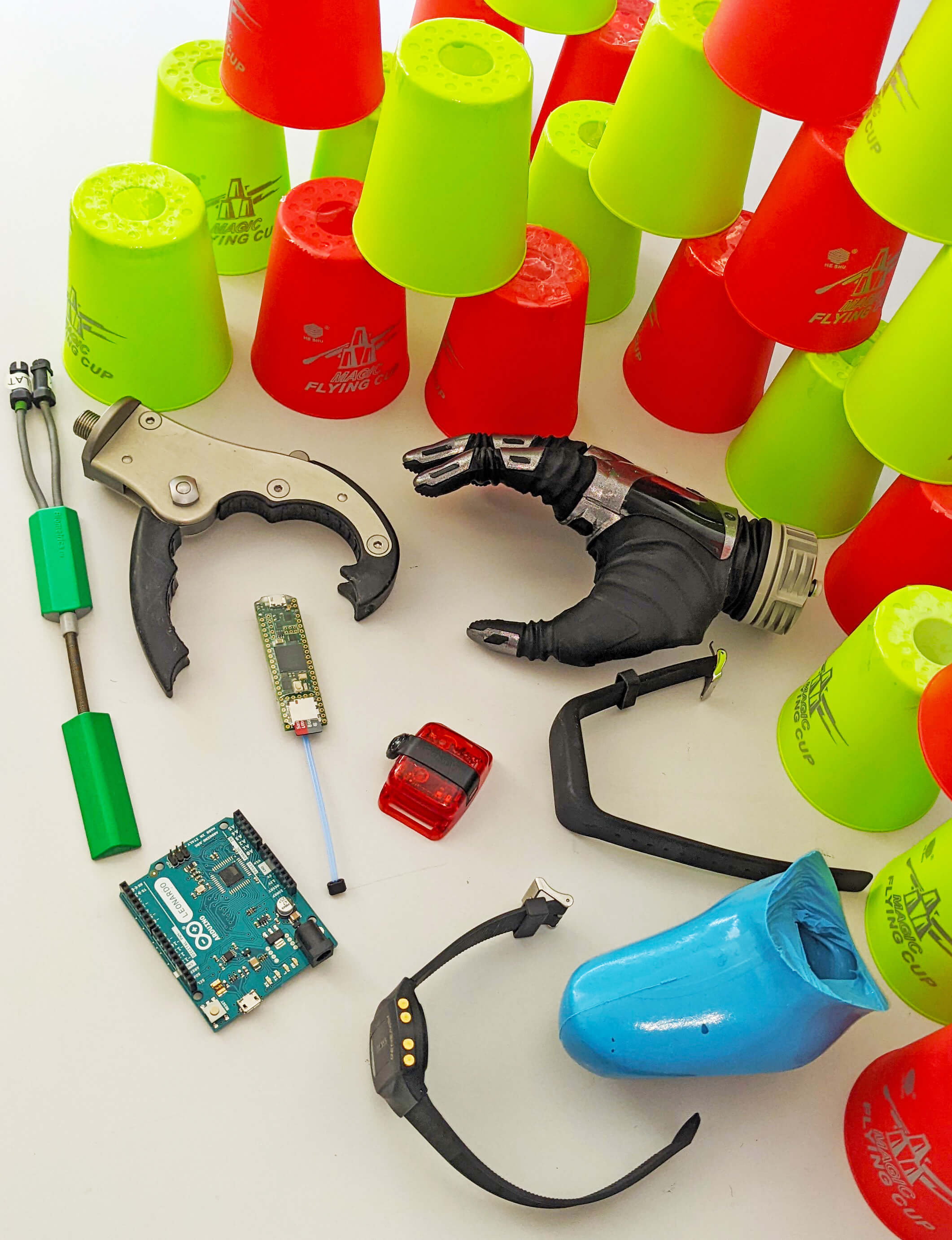
Equipment for the project including artificial hand and foot