About Engineering our Tomorrows
Engineering our Tomorrows gives young people the opportunity to increase their understanding of the diversity of uses and roles engineering offers and an awareness of the impact it makes. It ignites an excitement for engineering in children from all backgrounds to resolve evermore complex challenges and build the belief that they, too, can contribute effectively to better decision-making.
These goals were achieved by developing and delivering two, interactive and complimentary workshops that gave young people control of decision making in two engineering scenarios and then the tools and methods to evaluate these decisions and understand the impacts they were having. These workshops were: Home of Tomorrow and City of Tomorrow.
In Home of Tomorrow, young people can design a house with anything they want in it – and many suggested fantastic solutions to current problems and/or installed every luxury they could think of. Following this, discussions of energy needs were had and calculations were done to assess the houses they’d designed. This gave young people genuine and self-generated feedback on their own ideas, providing greater context and impact on what the design process involved. City of Tomorrow follows this same structure and expands upon the ideas of energy usage by looking into the sources of energy, the distribution of energy usage, planning the location of wind farms and the practicalities of transporting energy from source to user.
Collaborating with the engineers
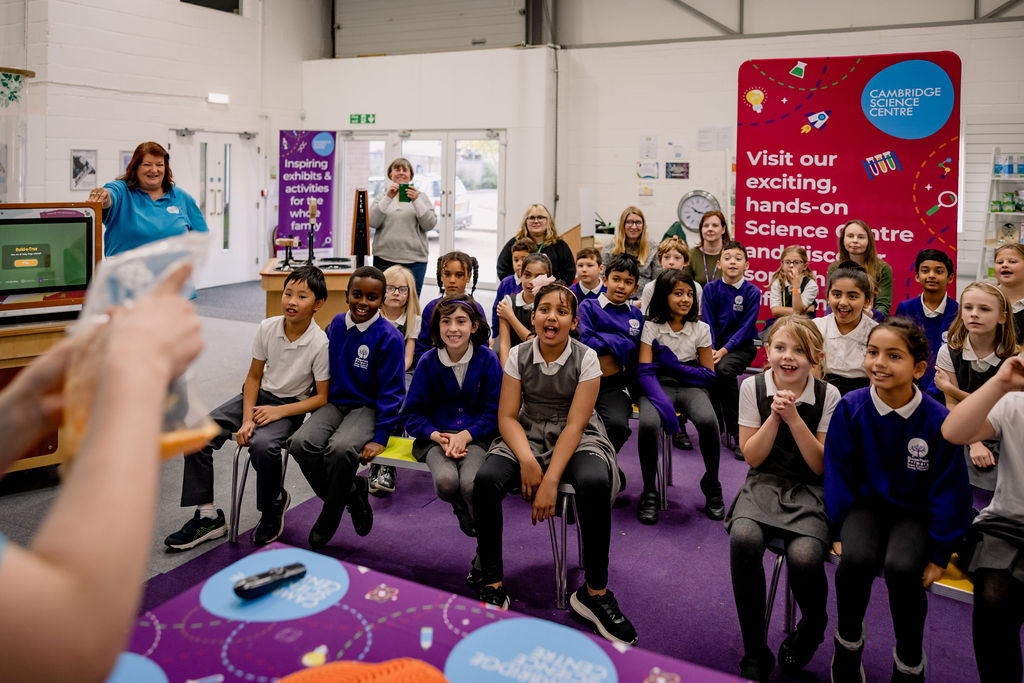
To develop these workshops, Cambridge Science Centre (CSC) worked with a team of engineers from the University of Cambridge’s Department of Engineering and associated groups (FIBE2, FPP and sensors CDT) to conceive, write, design and present the workshops to children age 7-13 years-old. The workshops were well received especially by the school groups, most of which were based in the underserved Fenland region of Cambridge and had not previously encountered any of CSC’s outreach offerings.
For CSC, working with the engineers provided a unique insight into the variety of their work, and how the different departments interact with each other. The team will maintain contact with these groups to keep a flow of specialist engineering knowledge into the ongoing development of products. The partnership was also beneficial for the engineers as they had not experienced presenting to younger school children before and developed new skills in science communication. Maintaining the relationship will allow the engineers to draw on CSC’s skills at any time.