
Practical AI is the Academy’s new event series, launched to share the realities of deploying AI in the systems we all rely on – from transport and housing to energy, utilities, and more. The focus is on the practical decisions that determine whether AI delivers tangible improvements for people and places: how data is gathered, how risk is managed, how trust is built, and how engineers, policymakers, and adopters solve problems together.
The second discussion in the series focused on infrastructure maintenance, and followed the publication of a National Engineering Policy Centre report, Reviving our Ageing Infrastructure. Through the experience of Tideway and Amentum, our speakers explored what happens when AI-enabled robotics are integrated into critical infrastructure inspection, how teams navigate the transition from trial to trusted operations, and what lessons can be learned.
London's super sewer and the inspection challenge
Until recently, a small amount of rainfall in London was enough to overwhelm the city's Victorian sewers, causing around 39 million tonnes of sewage to spill into the Thames each year. Each sewage spill adds nitrates and pathogens to the water, impacting the water quality and putting fish and swimmers at risk.
The Thames Tideway Tunnel, a "super sewer" with 1.6 million cubic metres of storage capacity, was designed to solve that problem. And since becoming fully operational in February 2025, it has captured over 14 million cubic metres of sewage.
But building the tunnel is only half of the challenge. Designed for a 120-year lifespan, it needs regular inspection to detect early signs of deterioration. Averaging 50 metres deep and stretching 25 kilometres as a single connected system, it can't be easily sectioned off for maintenance. Entering this confined space exposes inspectors to risk due to hazardous gases and limited access for emergency services. Managing this requires significant safety infrastructure, such as cranes, ventilation systems and rescue teams, and may leave the river unprotected for extended periods while the inspection takes place.
Building for the next century
Before the tunnel was built, Tideway decided that rather than sending people inside, they would send robots. This was not an obvious choice. In early 2010s, when Tideway secured its licence, robotics for infrastructure inspection was still a nascent proposition. Designing for human access would have been the obvious route, but Tideway chose to plan for remote inspection instead.
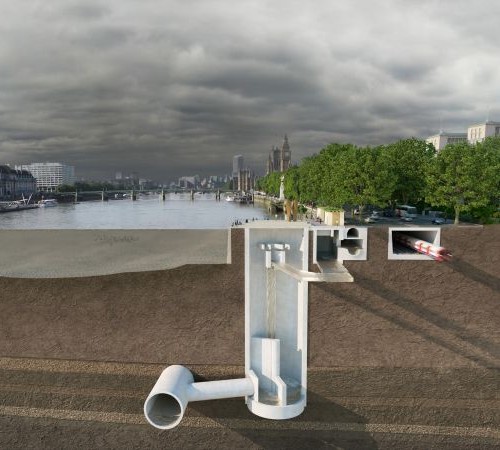
Cross section of tunnel and interception with the existing sewer network at Victoria Embankment.
Putting people down into a tunnel and moving along it several kilometres is full of risks. Other deep sewer systems have done this once or twice and then stopped doing it.
Roger Bailey, Tideway’s Chief Technical Officer
Roger Bailey, Tideway’s Chief Technical Officer, recalls the logic: “Putting people down into a tunnel and moving along it several kilometres is full of risks. Other deep sewer systems have done this once or twice and then stopped doing it.” Human inspection of comparable infrastructure has often been limited or discontinued, because the risks, the required safety apparatus, and the operational disruption were too high to justify repeating them routinely.
The alternative was to design the tunnel with robotic access in mind. This meant ensuring that shafts could accommodate lowering equipment, that the tunnel geometry would allow a wheeled robot to traverse its length, and that the infrastructure could support the communication systems required for remote inspection. If this worked, it would transform inspection from a rare, expensive, dangerous undertaking into something closer to routine maintenance.
Tideway’s first attempt, concluded in 2017-18. The technology proved two to three times more expensive than a conventional manual survey, so Tideway shelved the project, waiting for the technology to mature.
How the robotic inspection system works
When Tideway restarted the project in 2022, they took a different approach and started simple, instead of pursuing full autonomy from day one.
Amentum, a global engineering consultancy, developed the inspection system. The robot is lowered into the tunnel with a remotely operated lifting cage that doubles as a radio antenna, maintaining communication with operators at the surface. From above ground, operators can see what the robot sees and drive it through the tunnel – a process called teleoperation. The robot carries cameras and LiDAR sensors, building detailed 3D point clouds of the tunnel interior that can be compared against baseline surveys to identify any potential defects.
"The real challenge is that when you're that deep below surface level and that far down a tunnel, it's really complicated to keep communication," said Juliette Livet, a robotics engineer at Amentum who has been involved since early prototyping.
The radio communication was itself a breakthrough. Earlier attempts had assumed that maintaining a signal across seven kilometres of tunnel would be impossible, because the concrete walls and winding geometry seemed certain to block transmission. Amentum proved otherwise using radio technology.
Using AI for tunnel inspection
Rather than trying real-time autonomous navigation – the capability that had made the earlier attempt prohibitively expensive – AI is primarily used to accelerate post-processing, a major bottleneck. A single inspection run generates thousands of images. Without AI, someone would need to review each one manually, looking for cracks, blockages or other anomalies, which is a repetitive, attention-intensive task where humans are prone to error and machines tend to excel. " AI helped us do the inspection post-processing in less time and be more reliable,” – Juliette explained.
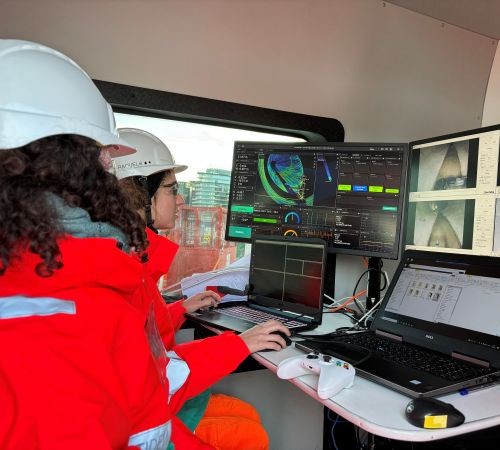
Operators driving the robot and capturing live data from control van
AI performs three main functions. First, it identifies distance markers painted inside the tunnel at known intervals. These markers allow the system to locate where the robot was at any point during its journey, which is essential for correlating any defects found with their exact position in the tunnel. Second, pre-trained computer vision models detect cracks in the tunnel lining, flagging areas that may need future attention. Third, object detection algorithms identify potential blockages.
The object detection illustrates a challenge common to AI deployment in novel environments: the absence of training data. When you’re the first to send a robot through a particular tunnel, there are no existing images of what ‘normal’. The team used what Juliette calls “a more primitive version of AI” with rule-based detection using parameters like object size and position rather than learned features. An object that’s large, static, and touching the ground is probably a blockage worth flagging. This approach is less sophisticated than deep learning, but it works when you’re starting from zero.
“When you put technology in an unknown environment for the first time, you might not be able to gather the type or quality of data you expected,” Juliette says. Each deployment improves the training dataset for the next one.
From trial to trusted operations
The trials demonstrated core capabilities in a controlled environment, but the tunnel was not yet in service.
In operational conditions, silt buildup and other factors could affect the robot's ability to transit reliably. When the tunnel is active, capturing sewage during storms, sediment builds up in unpredictable ways. The tunnel is designed to be self-cleansing over time – each new storm should flush accumulated material downstream – but between storms, there may be patches where the robot has to navigate around harder accumulations. “Until we have a little bit more understanding of how the system works in reality, it’s difficult to know quite what we’ll find,” Roger says. “That’s the key risk going forward."
If the robot can’t make it through reliably, Tideway has a fallback: the human survey methods, potentially alongside other approaches. But it’s likely that technology will continue to improve faster than problems accumulate. Drones, in particular, are advancing rapidly. Drones have already been used to survey shafts and near-surface structures during construction. In a year’s time, they may be capable of travelling further into the tunnel. A hybrid approach, combining robots for the main tunnel with drones for shafts and connecting passages, might prove more practical than either technology alone.
The ultimate ambition goes beyond periodic surveys. Remote inspection could become another tool in the asset management armoury – something that can be deployed within hours if there’s a suspected problem, rather than requiring months of preparation. If a construction project nearby accidentally strikes the tunnel, or sensors detect unusual movement, a robot or drone could be sent down almost immediately to assess the damage.
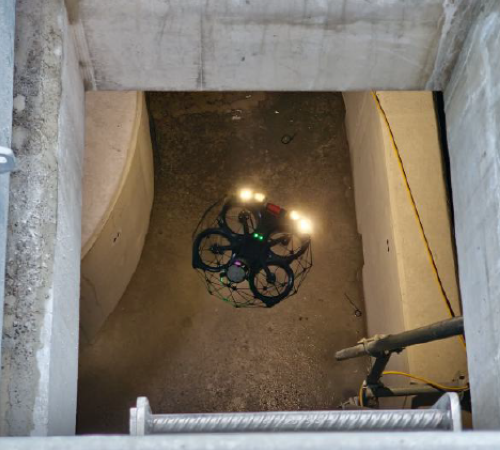
Drone inspecting the shafts and capturing live data.
Pro-innovation regulators
Companies often complain that regulators are too slow to approve new technologies or too quick to impose burdensome requirements. Here, the complaint is that regulators aren’t pushing hard enough. Nothing in the current frameworks prevents robotic inspection. The opportunity is for regulators to be more demanding.
“I think what we need regulators to do is actually challenge utilities to do more remote sensing,” Roger says. “Why aren’t you using remote devices to do this sort of work? I think they need to be more proactive and encourage organisations to do that and hold them to account if they don’t."
Remote inspection has advantages on three dimensions:
- safety: no workers in hazardous environments;
- data quality: machines capture everything systematically rather than relying on human attention; and
- environmental protection: shorter outages mean less time when the infrastructure isn’t functioning.
If the technology exists to achieve all three simultaneously, the question becomes why not?
What this tells us about Practical AI
The project offers several lessons for deploying AI in infrastructure more broadly.
Technology transfer across sectors can accelerate progress. Amentum brought proven approaches from industries that have been dealing with hazardous, hard-to-access environments for decades into water utilities.
The second lesson is that starting simple often beats starting sophisticated. “Set up a minimum viable product rather than something that’s perhaps super sophisticated and then crashes because you’ve tried to be too clever,” Roger says.
Another lesson is that novel environments require learning on the job. Without representative training data, AI models cannot be pre-trained in the conventional sense. The team built their understanding through deployment, using simpler detection methods initially and accumulating the dataset needed for more sophisticated approaches over time. This is the opposite of how AI is typically presented as a technology you train once and then deploy but it may be more realistic for infrastructure applications where every asset is different.
Takeaways
The project offers the following lessons for deploying AI in infrastructure:
- Design choices made early determine what is possible later. Infrastructure that is not designed with future automation in mind can be more difficult to adapt later.
- Start with a minimum viable capability, not maximum sophistication. An earlier push for full autonomy proved technically impressive but economically unviable. Focusing on teleoperation with targeted AI delivered most of the value at a lower cost.
- Technology transfer can accelerate progress. Adapting proven approaches from other sectors can leapfrog years of development.
- Hybrid approaches may outperform single solutions. Combining several technological solutions, such as AI analytics, robots and drones, can prove more practical than relying on any single technology, especially as capabilities advance at different rates.
- Novel environments may require learning through deployment. Without data, AI models can’t be pre-trained. Iterative deployment to accumulate datasets over time may be more realistic for infrastructure applications.
- Regulators can be drivers of adoption. Rather than merely permitting new approaches, regulators could actively challenge infrastructure operators to adopt innovation.
- Remote inspection can enable proactive, preventative maintenance. If inspection can be deployed within hours, rather than planned months in advance, it can become a routine tool for early intervention, rapid reassurance after suspected incidents and safer longer-term stewardship of infrastructure.